
October 15, 2026
For Immediate Release
Contact: Aliza Shatzman, 267-481-2095, aliza.shatzman@legalaccountabilityproject.org
Harvard, Georgetown, and NYU Lead The Legal Accountability Project’s Clerkships Database Subscribers By Law School for 2025–26
Two and a half years after launching its first-in-the-nation Clerkships Database in April 2024, The Legal Accountability Project (LAP) continues to revolutionize judicial clerkship hiring by democratizing access to candid, never-before-seen insights about judges as managers and judicial work environments. What was once considered an improbable undertaking—fostering nationwide transparency in one of the legal industry's most secretive and entrenched spaces—has become an indispensable resource for thousands of aspiring judicial clerks.
LAP's innovative Clerkships Database, often described as "Glassdoor for Judges," empowers law students and recent graduates to make informed career decisions rather than relying on opaque clerkship "whisper networks," historically controlled by well-connected law schools and shared selectively with students. Since its launch, LAP’s Database has served more than 4,000 law students and recent graduates nationwide, transforming a system in which applicants historically knew far too little about the judges they hoped to work for.
During the Database's second year, LAP doubled its reach to approximately 2,000 subscribers, demonstrating the enormous demand for independent, verified clerkship information. For the 2025–26 school year, more than 1,200 students and recent graduates subscribed to the Database. Subscribers’ continued willingness to invest in candid clerkship information underscores the value of LAP's platform and the importance of transparency in clerkship hiring.
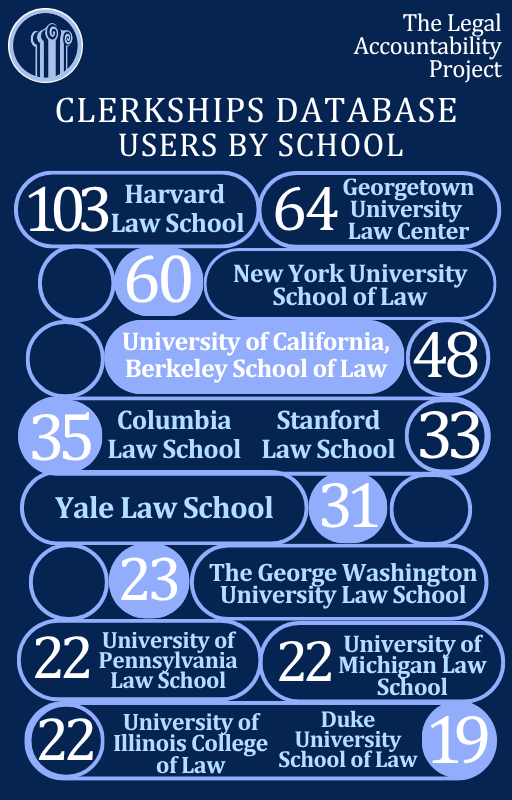
Here are the 12 leading law schools by number of Clerkships Database student users during the 2025–26 school year:
Harvard Law School — 103
Georgetown University Law Center — 64
New York University School of Law — 60
University of California, Berkeley School of Law — 48
Columbia Law School — 35
Stanford Law School — 33
Yale Law School — 31
The George Washington University Law School — 23
University of Pennsylvania Law School — 22
University of Michigan Law School — 22
University of Illinois College of Law — 22
Duke University School of Law — 19
These numbers reflect strong engagement from students at some of the nation's most prestigious law schools, while highlighting the continued need for an independent resource accessible to aspiring clerks regardless of law school affiliation. Harvard again leads the list, while Georgetown, NYU, and Berkeley round out the top four.
As LAP highlighted in last year's announcement of Clerkships Database subscribers by law school, demand for candid clerkship information extends well beyond any one law school or group of institutions. LAP’s decision to shift to full-price subscriptions during the 2025-2026 school year also underscores the importance of eliminating financial barriers that could prevent aspiring clerks from accessing critical information about prospective employers.
LAP continues to encourage law schools to subscribe to the Database on behalf of their students for just $5 per student per year. Law schools that pride themselves on robust clerkship advising should recognize that access to candid, verified information about judicial work environments is a necessary component of preparing students for successful, healthy, and balanced legal careers. Providing this judicial clerkship information, in turn, should be part of law schools’ moral and ethical commitment to students, given that schools in turn benefit from their alumni’s success as judicial law clerks.
Ensuring that applicants can avoid abusive judges remains particularly urgent. Judicial clerkships are among the most coveted early-career opportunities in the legal profession, yet clerks face enormous power imbalances and limited avenues for redress when judges mistreat them. Just during the 2025-26 school year, numerous judicial misconduct incidents made national news–a fraction of the judges who actually mistreat their clerks, behind closed doors, when no one is watching and no one is empowered to file a complaint, let alone speak with the press. LAP's Database addresses these longstanding injustices by empowering former clerks to share their experiences safely and anonymously, without fear of retaliation, while also empowering aspiring clerks to learn from them, creating accountability through transparency where before there was none.
LAP has already upended the judicial clerkship system, demonstrating that innovative legal technology can disrupt even the most entrenched corners of the legal industry. But LAP’s work is far from finished. Law schools must step up, work with us, and ensure every aspiring clerk has access to the information they need to make informed career decisions.
LAP is proud that thousands of law students and recent graduates turn to our Database each year for candid clerkship information. We look forward to continuing to transform judicial clerkship hiring, foster workplace transparency, and hold the judiciary to higher standards of workplace conduct in the years ahead.